This post contains affiliate links.
I remember stepping outside on my third morning in Seoul and thinking I was looking at fog. It wasn't fog. It was yellow dust — 황사 — blowing in from the Gobi Desert, mixed with PM2.5 from Chinese industrial regions and a generous dose of construction dust from whatever apartment complex was going up three blocks away. A friend in Seoul had warned me. I didn't really believe her until I saw the AQI app sitting at 178 and felt my throat scratchy before I'd even had coffee.
If you're reading this, you probably already know air quality in Korea is a real thing. Maybe you've already seen the 미세먼지 (fine dust) warnings on the subway screens. Maybe a Korean coworker has told you matter-of-factly: "today is bad, don't go outside without a mask." The point is — if you're living here and you haven't bought an air purifier yet, this post is for you.
Why Western Review Sites Will Steer You Wrong
Here's the thing about Wirecutter or The Spruce or any English-language review site: they're writing for American homes. The brands they recommend — Coway, Winix — are actually great brands. But when they tell you which model to buy, they're thinking about a 400 square foot open-plan living room in a Portland apartment, not your 15평 (about 50 m²) Korean studio with a separate bedroom that's essentially a closet.
Room size matters a lot for air purifiers. Every model has a rated coverage area (평수 or m²), and buying the wrong size means either you're running it at maximum and it's too loud to sleep, or you're running it at medium and it's not actually cleaning the air. Korean apartments are typically smaller and more compartmentalized than Western ones. The machines Wirecutter recommends are sometimes overkill for the main room, and then you realize you need a second unit for the bedroom anyway.
So let's talk about what actually makes sense here.
The Brands Koreans Actually Buy
Walk into any Korean electronics store — Lotte Hi-Mart, Samsung Digital Plaza, E-Mart — and you'll notice the air purifier section is dominated by three names: Winix, Coway, and LG PuriCare. Xiaomi shows up too, especially at the budget end.
Koreans are extremely aware of air quality. They've been dealing with 황사 and 미세먼지 for years. They know what works. The fact that Winix and Coway are popular here isn't just marketing — these brands have been selling to people who genuinely need effective air purification.
You might wonder about Dyson. Here's the honest answer: Koreans don't really think of Dyson as an air purifier brand. Dyson is the vacuum brand. They make air purifiers too, but at ₩400,000–700,000+ they're in a completely different price bracket, and most Koreans would look at you like you'd suggested buying a Ferrari to commute to work. Great engineering, absurd price, questionable value for what you're actually getting.
Xiaomi purifiers sit at the other end — you can find the Xiaomi Smart Air Purifier 4 on AliExpress for around ₩60,000–80,000. They work. But I'll get to that in a minute.
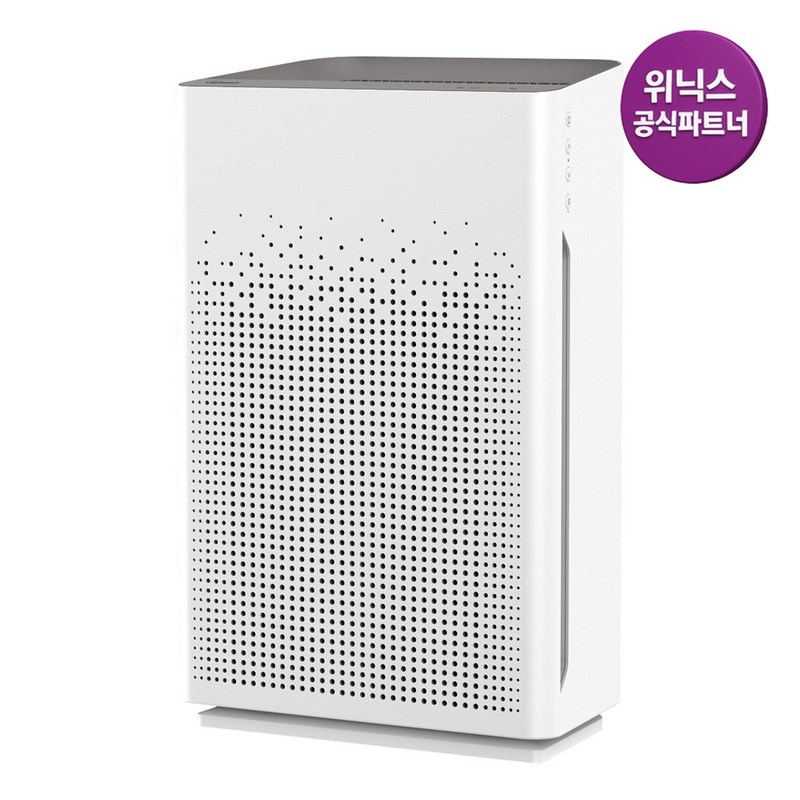
What I Actually Recommend: Winix Zero
For most Korean apartments, the Winix Zero is the sweet spot. It runs around ₩169,000 on Coupang (prices fluctuate, check current listing).
Why this one specifically? A few reasons.
The Winix Zero covers up to 19평 (roughly 63 m²), which is perfect for a typical 1LDK or 2LDK Korean apartment room. It's not trying to clean an American McMansion. It runs quietly enough that you can sleep with it on — which matters, because Seoul apartments can get genuinely dusty overnight, especially if you have windows that don't seal well.
The HEPA + PlasmaWave combination actually does something. The HEPA filter catches particles. The PlasmaWave technology helps with odors and VOCs, which matters more in Korea than you might think — Korean apartments often have relatively new construction with off-gassing materials, and cooking smells in smaller spaces are real.
It also has an auto mode with a particle sensor, which means you don't have to manually adjust it when the 미세먼지 levels spike. The fan kicks up automatically, does its thing, then dials back down. Very set-and-forget.
For a detailed look at the machine itself, see the Winix Zero detailed review →
Figuring Out the Right Size for Your Place
Here's a rough guide for Korean apartment sizes:
Studio / 원룸 (원룸, 10–15평 / 33–50 m²): One purifier rated for 15–20평 placed centrally will cover the whole space. The Winix Zero handles this comfortably.
1LDK / 방 1개 오피스텔 (15–20평 / 50–66 m²): Same deal — one unit for the main living space is usually enough, though if your bedroom is a sealed room you'll feel the difference more. Consider whether you want it in the bedroom or living area, or budget for two smaller units.
2LDK / 방 2개 (20–30평 / 66–99 m²): You'll want either one larger unit (Winix Zero Pro or Coway AP-1516D) in the living room, or one mid-size unit per key room. Two Winix Zeros is a popular setup among expats I know — one for the main area, one for the bedroom.
Don't go by the apartment's total 평 size. Go by the room you're placing it in. Walls matter.
Where to Buy (And Why Coupang Is the Answer)
Coupang Rocket Delivery. Order tonight, it's at your door tomorrow morning. For something you're going to use every single day, this is the right move.
Coupang also has good pricing — usually close to the official brand price, and during sales events (11/11, Coupang's own promotions) you can knock ₩20,000–30,000 off. Check the app, add to cart, and watch the price.
One thing foreigners worry about: will there be an English customer service experience? Coupang is Korean, but returns and exchanges on Rocket Delivery items are genuinely painless — you request it in the app (there's a translation-friendly flow), a courier picks it up from your door. You don't need to explain yourself to anyone in Korean.
Filter Costs — The Real Long-Term Question
This is what people forget to check before buying. The machine is a one-time cost. The filters are forever.
For the Winix Zero, replacement filters run about ₩30,000–45,000 for a HEPA filter set, which you'd replace every 6–12 months depending on air quality. In Korea, during heavy 미세먼지 seasons, you'll probably be closer to the 6-month end if you run it often.
The good news: Winix and Coway filters are widely available on Coupang, always in stock, and ship next day. You're not going to be stuck hunting for a specialty filter at a Korean store you can't navigate.
Some cheaper brands — especially no-name units — have filters that are either unavailable on Coupang or require you to order from the brand's Korean website with no English support. That's a nightmare you don't need.
What About Cheap AliExpress Air Purifiers?
Yes, there are ₩30,000–50,000 air purifiers on AliExpress. Some of them look fine. Some of them even have legitimate HEPA filters.
Here's my honest take: for something you're running 8–12 hours a day in a closed room, breathing the output of, I wouldn't go no-brand from AliExpress. Not because all of them are bad — some are fine — but because you have no way to verify the filter quality, no local warranty, and no easy way to get replacement filters when the time comes.
Xiaomi is the exception. If you want budget, Xiaomi is a real brand with actual QC, and their purifiers are solid. But even then, Winix at ₩169,000 isn't that much more than a real Xiaomi unit by the time you're comparing equivalent models.
Get the known brand. Your lungs are involved.
Quick Summary
Yellow dust season in Korea runs roughly February through May, but PM2.5 is a year-round issue in Seoul and most of the major cities. An air purifier isn't a luxury here — it's closer to a necessity, especially if you work from home or have kids.
The Winix Zero at ₩169,000 is what I'd tell any newcomer to buy first. It's the brand Koreans trust, it's the right size for Korean apartments, the filters are easy to find on Coupang, and the machine will just quietly do its job in the corner without drama.
Order it on Coupang. It'll be there tomorrow.
See also: Winix Zero detailed review →