TL;DR: Magic Chef countertop dishwasher gets buy recommendation for solo living - 15 minute setup, water efficient, perfect capacity for one person.
What's the worst chore when you live alone? For me, it's doing the dishes — no contest.
Cook one meal and suddenly your sink is full: pot, frying pan, plates, utensils, cups. You tell yourself "I'll do it later," and later turns into tomorrow morning, which turns into a mini ecosystem of regret. In summer it starts to smell. Lovely.
Built-in dishwashers cost well over $800 with installation — not happening in a rental studio. But then I discovered compact countertop dishwashers that hook up to your faucet with zero plumbing work.
That's how I ended up with the Magic Chef compact dishwasher two months ago.
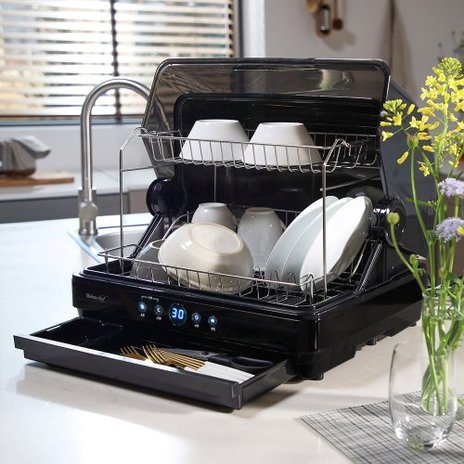
How long does setup take?
The "no installation" marketing isn't exaggerating. The box includes the unit, an inlet hose, a drain hose, and a faucet adapter. You:
- Clip the adapter onto your faucet
- Connect the inlet hose
- Drape the drain hose into the sink
Done. No tools, no plumber, no landlord permission needed. I finished setup in 15 minutes with just the included manual.
If your faucet doesn't fit the adapter, there's also a manual fill option — you pour water directly into the top of the machine. It works, but connecting to the faucet is way more convenient. One wash cycle uses roughly 5 liters of water, compared to 30~40 liters for hand washing. So it's actually more water-efficient too.
How much can it hold?
This was my biggest concern. Verdict: totally fine for one person.
A typical meal load fits 2 rice bowls, 1 soup bowl, 2~3 side plates, a set of utensils, and 1~2 cups. That covers a full solo meal easily, and two people's dishes still fit with a bit of Tetris.
The catch: large cookware doesn't fit. A 26 cm frying pan? No chance. Small saucepans under 20 cm squeeze in, but big pots and pans still need hand washing. That's just the reality of compact dishwashers.
Pro tip: Angle dishes so they don't overlap. If they're stacked flat, water can't reach the inner surfaces and things come out half-clean.
Does it actually clean well?
This is the real selling point. The machine washes at over 70°C, and the difference versus hand washing is dramatic.
Cases where it really shines:
- Curry-stained plastic containers — hand washing leaves yellow residue; the dishwasher gets it spotless
- Greasy plates after frying — high-temp water plus dishwasher detergent is an unbeatable combo
- Coffee stains inside tumblers — reaches spots your sponge can't
The high temperature also means sanitization. I've seen parents use these for baby bottle sterilization, and honestly, that tracks.
There's a drying function too — hot air circulates after the wash cycle so dishes come out dry to the touch. It's a small thing, but it feels great.
What wash cycles are available?
There are several modes, but I mainly use three:
- Standard: ~90 minutes. For regular meals. Best cleaning results
- Quick: ~30 minutes. For lightly used cups and plates
- Intensive: ~120 minutes. For heavy grease — post-curry or stew situations
I usually start the standard cycle after dinner and watch YouTube while it runs. My involvement: zero. That's the whole point.
How much does it cost to run?
The unit draws about 700~730W. Running it once a day for 90 minutes works out to roughly $2~3 per month in electricity. Barely noticeable on the bill.
You do need dishwasher-specific detergent — regular dish soap will produce an absurd amount of foam and overflow everywhere. Dishwasher detergent costs about $3~5/month bought in bulk. Adding rinse aid occasionally prevents water spots and improves results.
What are the main drawbacks?
1. It takes up counter space The footprint is roughly 45 × 45 × 42 cm — about the size of a microwave. In a tiny studio kitchen, that's significant. I bought a small steel shelf (~$15) and put it on that next to the sink.
2. It's not silent There's a consistent whirring and water-sloshing sound during operation. Quieter than a washing machine's spin cycle, but noticeable in a studio apartment at night. I run it around 8~9 PM and it's fine. If you're noise-sensitive, plan accordingly.
3. Pre-rinse helps Hardened rice or large food chunks can survive the cycle. A quick rinse before loading — not a full wash, just knocking off debris — makes a real difference.
4. Not everything is dishwasher-safe Wooden utensils, lacquerware, and some non-stick coatings don't love high-temperature washing. Check for dishwasher-safe labels, especially on plastics.
Is it worth buying after two months?
When I told people I bought a dishwasher for my studio, I got the "isn't that a bit much?" look.
Let's do the math. I used to spend 15~20 minutes on dishes daily. That's 7~10 hours per month, or 90~120 hours per year. A $200 machine takes that off my plate (literally).
But honestly, the bigger win is mental. Cooking stopped feeling like a burden because I no longer dread the cleanup. I actually cook more now, which means less takeout, which means more savings. The machine arguably pays for itself.
If I could add only one appliance to a studio apartment, it would be a compact dishwasher. Before an air fryer. Before a robot vacuum. This one.
Frequently Asked Questions
Q: Are AliExpress home appliances good quality?
Many are surprisingly good for the price. Focus on products with high sales volume (1,000+) and positive reviews (90%+). The key is doing your research before buying.
Q: Do I have to pay customs duty in Korea?
Orders under $150 (about 200,000 KRW) are duty-free. Above that, you may pay 8-13% customs duty depending on the product category.
Q: What if the product arrives damaged or defective?
AliExpress has a Buyer Protection policy. You can open a dispute within 15 days of delivery for a refund or replacement. Always save photos and videos as evidence.
What are similar alternatives?
- LG Styler 8-Month Review: I Bought It for BBQ Smell and Now I Can't Live Without It
- Paseco Window Air Conditioner Review — The Best No-Outdoor-Unit AC for Small Apartments (2025)
- Wireless Car Vacuum Cleaner Review — Powerful Handheld Rechargeable Vacuum
This post contains affiliate links.